

Does Your Community Association Have an Emergency Plan?
Most don’t, and that’s the risk. Government agencies and private businesses maintain formal disaster response plans as a matter of course. Most condo and HOA boards, by contrast, have no documented plan at all until the night a fire breaks out,; a hurricane makes landfall, or a building system fails, and the board is left improvising decisions that affect hundreds of residents in real time. A couple of terms worth defining first: Emergency powers statute: Florida law (F.S. 718.1265 for condominiums, F.S. 720.316 for homeowners’ associations) that grants boards specific authority to act during a declared state of emergency, including access to units, emergency repairs, and certain financial decisions without the usual advance notice requirements. Disaster response plan: A documented, board- adopted plan defining roles, responsibilities, communication methods, and decision-making authority before, during, and after a disaster. Why Does a Community Association Need a Formal Emergency Plan? Because disasters don’t

A Complete Budget Season Planning Guide for Condo and HOA Boards
Florida condominium and homeowners’ associations are legally required to prepare an annual budget – and it’s far more than a formality. Florida’s annual budget requirements sit in statute, and the budget itself becomes the financial plan the entire association year runs on, as well as the benchmark owners use to judge how well the board managed the community’s money. Three terms are worth defining before we walk through the process: Working capital: The association’s operating fund balance – essentially its short-term cash cushion for day-to-day expenses, separate from reserves. Reserve funding: Money set aside in the budget specifically for major future repairs and replacements. Special assessment: A one-time additional charge to owners, typically used when the operating fund or reserves fall short of what’s actually needed. Who Is Responsible for Preparing an HOA or Condo Budget? Who prepares a condo association budget? It starts with the community association manager (CAM),
The Fine Print: Legal Updates Every Community Association Should Know
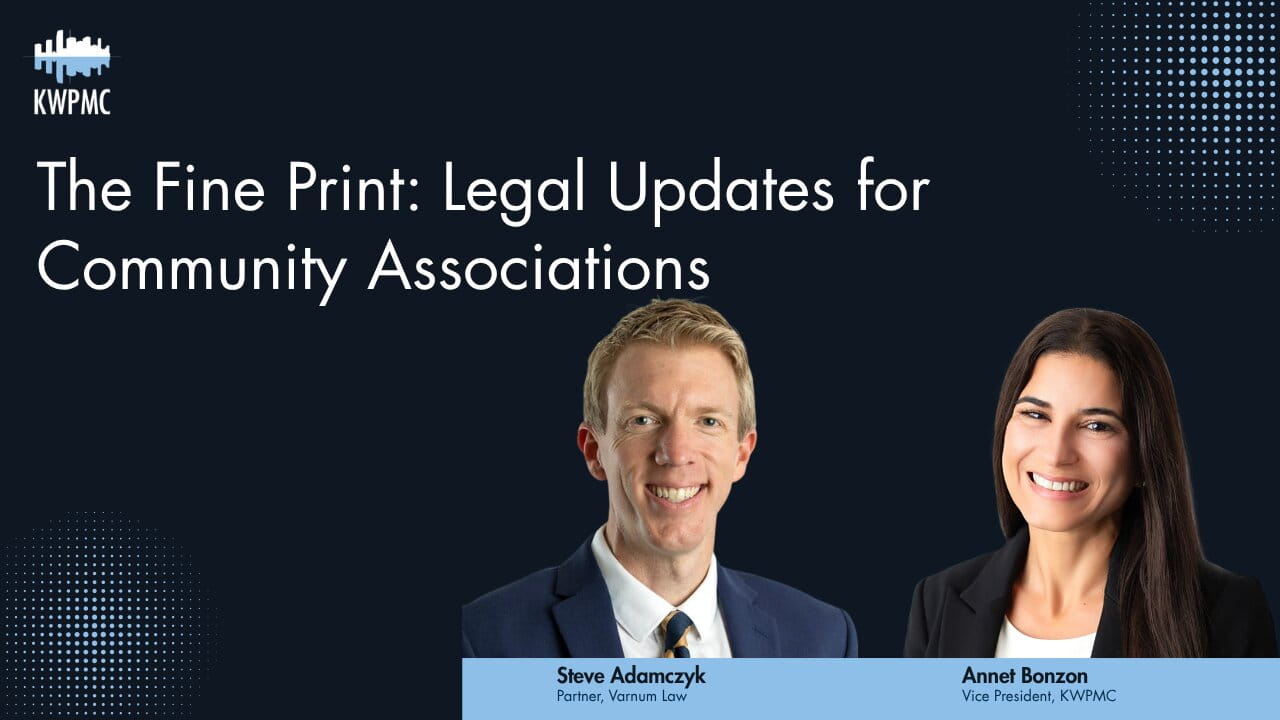
Legal updates can feel overwhelming – but they don’t have to be. That was the framing Alex Martin, Partner at KW Property Management & Consulting (KWPMC), set at the top of KWPMC’s latest legal webinar, The Fine Print: Legal Updates for Community Associations. Joining Martin and KWPMC Executive Vice President Zuly Maribona were Annet Bonzon, KWPMC Vice President and active CAM instructor, and Steven Adamczyk, a Naples-based partner with statewide Florida community association law practice Varnum. The panel covered three developments reshaping condo and HOA governance in 2026: new Fannie Mae reserve requirements, the growing legal risk of AI in board decision-making, and a Florida Supreme Court ruling on firearms in common areas. As always, this recap is for general information only – associations should confirm how these updates apply to them with their own legal counsel. Fannie Mae’s New Reserve Requirements Are Reshaping Condo Financing The most pressing update,

Can an HOA or Condo Budget Committee Meet Privately in Florida?
Florida law treats most budget committee meetings the same way it treats board meetings: they must be open to all unit owners and properly noticed in advance. If a committee is helping shape the association’s budget review numbers, discuss priorities, or forming a recommendation for the board, that process is meant to happen where owners can see it, not behind closed doors. A board can’t quietly adopt a budget “on the committee’s recommendation” without residents having had the right to attend the meeting where that recommendation was made. Open meeting requirement: A Florida statutory rule requiring certain meetings, including many committee meetings, to be accessible to all members, with advance public notice, rather than held as a closed session only board members or staff can attend. Requirements for Budget Committee Meetings in Florida Under F.S. 718.112(2)(c)4, any committee that makes budget recommendations to the board, or takes final action on

How Healthy Are Your Condo Association’s Reserves?
A “healthy” condo reserve fund is one large enough to cover future major repairs and replacements without forcing a special assessment and for many structural components in Florida, state law requires that account to be fully funded, not just adequately funded. That’s a significant shift from just a few years ago, and it’s one every board and owner needs to understand. A few terms worth defining before going further: Reserve fund: Money set aside separate from day-to-day operating funds to pay for major future repairs and replacements: roofing, structural work, elevators, painting, and similar capital items. Reserve study: A professional assessment of a property’s age, condition, and expected lifespan of major components, used to project how much money the reserve fund needs and when. SIRS (Structural Integrity Reserve Study): A Florida-specific reserve study required for condo and cooperative buildings three stories or taller, covering structural components like the roof, load-bearing