
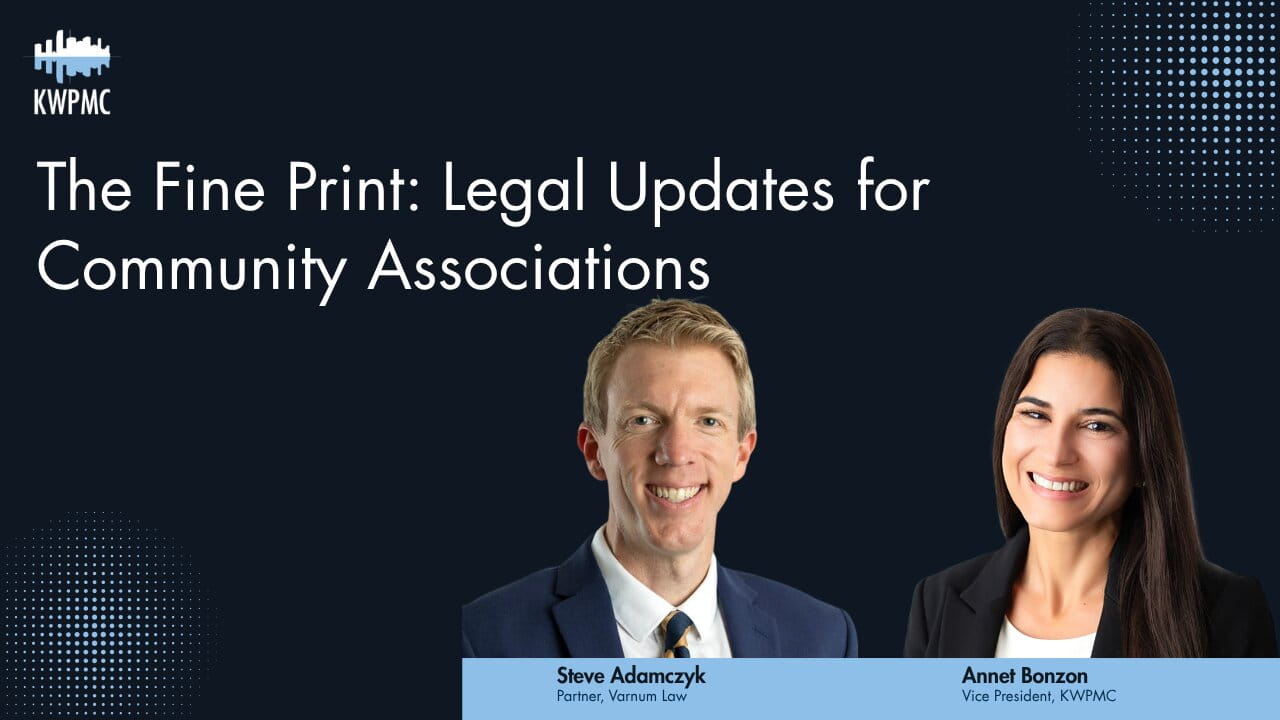
Legal updates can feel overwhelming – but they don’t have to be. That was the framing Alex Martin, Partner at KW Property Management & Consulting (KWPMC), set at the top of KWPMC’s latest legal webinar, The Fine Print: Legal Updates for Community Associations. Joining Martin and KWPMC Executive Vice President Zuly Maribona were Annet Bonzon, KWPMC Vice President and active CAM instructor, and Steven Adamczyk, a Naples-based partner with statewide Florida community association law practice Varnum.
The panel covered three developments reshaping condo and HOA governance in 2026: new Fannie Mae reserve requirements, the growing legal risk of AI in board decision-making, and a Florida Supreme Court ruling on firearms in common areas. As always, this recap is for general information only – associations should confirm how these updates apply to them with their own legal counsel.
Fannie Mae’s New Reserve Requirements Are Reshaping Condo Financing
The most pressing update, according to Adamczyk, involves Fannie Mae’s underwriting requirements for condominium loans – a change that’s landing squarely in the middle of budget season.
“The greatest issue that they had was condominiums and their borrowers being unable to deal with large, unexpected capital projects,” Adamczyk explained. In response, Fannie Mae now requires associations to direct roughly 15% of qualified assessment revenue toward reserves – up from 10% – after excluding reserve contributions, pass-through utility charges, and certain other revenue.
There are two paths to approval: hit that 15% threshold, or maintain an approved reserve study updated every three years (compared to the 10-year cycle required for Florida’s Structural Integrity Reserve Study, or SIRS). That distinction matters – Adamczyk noted that a strong SIRS study doesn’t automatically satisfy Fannie Mae, since Fannie Mae requires the schedule to include anything the association replaces, not just structural components like elevators.
Two additional wrinkles are worth flagging for condo boards:
- Fannie Mae also doubled the allowable per-unit insurance deductible, making underwriting easier on that front – but insurance is not excluded from the reserve percentage calculation.
- Loans, special assessments, and lines of credit can’t count toward the 15%, even though current Florida law allows associations to count them as reserve funding.
“It’s on your doorstep whether you like it or not,” Adamczyk said, pointing out that boards don’t have a legal duty to be Fannie Mae compliant, but noncompliance shrinks the pool of buyers who can obtain financing – which affects resale values for the entire community. His advice: talk to your property accountant and reserve analyst now, before a seller finds out the hard way that their buyer doesn’t qualify.
AI in the Boardroom: A Powerful Tool With Real Legal Risk
Perhaps the most eye-opening portion of the session focused on how AI tools are quietly creating legal exposure for boards and management teams.
The core issue is attorney-client privilege. When a board member or manager pastes a privileged legal opinion into a free, public AI tool to get a summary, they may be waiving that privilege – because most free accounts include consent language allowing the platform to use those inputs. “Some courts, not in Florida, have held that that’s a waiver of attorney-client privilege,” Adamczyk said. In active litigation, that can mean opposing counsel subpoenas AI inputs directly, potentially exposing an attorney’s full assessment of a case’s weaknesses.
The fix isn’t to avoid AI altogether – Bonzon noted that KWPMC uses its own closed, internal AI system precisely to avoid this exposure. Adamczyk agreed that a closed system is a meaningfully different situation: “That’s clearly no different than you walking down the hall talking to one of your colleagues.” His recommendation for boards vetting a management company: ask directly whether they use a closed AI system and whether staff are trained on how to use it responsibly.
The panel also flagged a pattern of AI-generated misfires — board members and residents submitting confident-sounding but legally wrong analysis generated by public chatbots. One example: an owner requesting a disability accommodation cited the Americans with Disabilities Act, which doesn’t apply to private residential communities (the Fair Housing Act does). Another: a board member’s AI-generated research claimed a nonexistent mandatory mediation requirement in a construction defect case. As Adamczyk put it, “It’s an amazing tool, but it is still a tool” – not a substitute for legal counsel.
Florida’s Open Carry Ruling Puts HOA Firearm Rules in a Gray Area
A recent Florida Supreme Court decision found the state’s concealed-carry permit requirement unconstitutional, effectively opening the door to open carry in many public spaces. The ripple effect for HOAs: can a private community still prohibit firearms in the clubhouse, pool area, or management office?
Adamczyk described a wave of boards adopting or amending rules restricting firearms in common areas following the ruling – followed by the Florida Attorney General taking what he called an “overly aggressive interpretation” of an unrelated statute (originally about employees’ cars in workplace parking lots) to argue that HOAs may not be able to restrict firearms in common areas at all.
Notably, even amending governing documents through a full membership vote may not fully insulate an association. “Even if you had 99% of the membership vote in favor of a restriction… it could still be deemed illegal,” Adamczyk said, comparing the situation to established board authority over conduct in common areas – like banning smoking or requiring swimwear at the pool – where the outcome here remains genuinely unsettled.
His guidance for boards: there’s no one-size-fits-all answer. Communities that want to prohibit firearms entirely should be prepared to defend that position against Attorney General scrutiny; communities that prefer a permissive approach should recognize the impact on residents who may feel differently. Either way, this is a board-level policy decision that calls for legal counsel, not a rule adopted reactively.
AI Is Also Driving a Surge in Records Requests
A related, newer issue: AI is dramatically inflating the length and complexity of official records requests and written inquiries. Adamczyk described requests that used to be a page or two now running dozens of pages, KW PROPERTY MANAGEMENT & CONSULTING, LLC • 8200 NW 33rd Street, Suite 300, Miami, FL 33122 • (786) 363-1935 generated by residents feeding broad prompts into AI tools. “This records request looks like a subpoena in litigation, because that’s what AI is thinking,” he said.
His recommendation is for boards to proactively adopt reasonable rules on the frequency, scope, and format of records requests and written inquiries – within the limits the statute allows – and to designate a specific point of contact for records requests so that response deadlines aren’t missed simply because a request landed in the wrong inbox.
FAQ: Legal Updates for Condo and HOA Boards
Q: What is Fannie Mae’s new reserve requirement for condos?
A: Fannie Mae now generally requires about 15% of a condo association’s qualified assessment revenue to go toward reserves in order for buyers to qualify for conventional financing – up from a prior 10% threshold – unless the association instead maintains an approved reserve study updated every three years.
Q: Does a Florida SIRS study automatically satisfy Fannie Mae’s requirements?
A: Not necessarily. Fannie Mae’s reserve schedule must include any component the association replaces, not just the structural items covered by Florida’s Structural Integrity Reserve Study, and must be updated every three years rather than the SIRS’s 10-year cycle.
Q: Is it safe to put privileged legal advice into ChatGPT or another public AI tool?
A: Caution is warranted. Entering privileged attorney communications into a free, public AI platform may waive attorney-client privilege in some jurisdictions, since those platforms’ terms often permit use of submitted content. A closed, internal AI system is a meaningfully different – and lower-risk – scenario.
Q: Can our HOA still prohibit firearms in common areas?
A: It’s currently a legally unsettled, board-level policy decision following a Florida Supreme Court ruling and a contested Attorney General interpretation. Associations considering firearm rules or amendments should consult legal counsel before adopting or changing a policy.
Q: Can our board limit how many records requests an owner submits?
A: Yes, within reasonable limits. Florida statutes allow associations to place limits on the frequency, duration, and scope of records requests and written inquiries. Adopting a clear, board-approved policy – including a designated recipient for requests – is a recommended best practice, especially as AI-generated requests grow longer and more complex.
Staying Ahead of What’s Next
As Zuly Maribona closed the session: “Communication is key through this process” – with legal counsel, with your management team, and with residents. Legal and regulatory change isn’t slowing down, and the associations best positioned to manage it are the ones staying informed and asking questions before an issue lands on their doorstep.
Have questions about how these updates affect your community?
This recap is general information only – reach out to your KWPMC representative to connect with your management team and legal counsel on what applies to your association.